FROM CREATING MESSAGES TO MANAGING COMMUNICATION AS A SYSTEM.
Business Context
A 0→1 internal communication platform concept for the teams responsible for communication across an organization.
Communication isn't one message — it's a series of decisions.
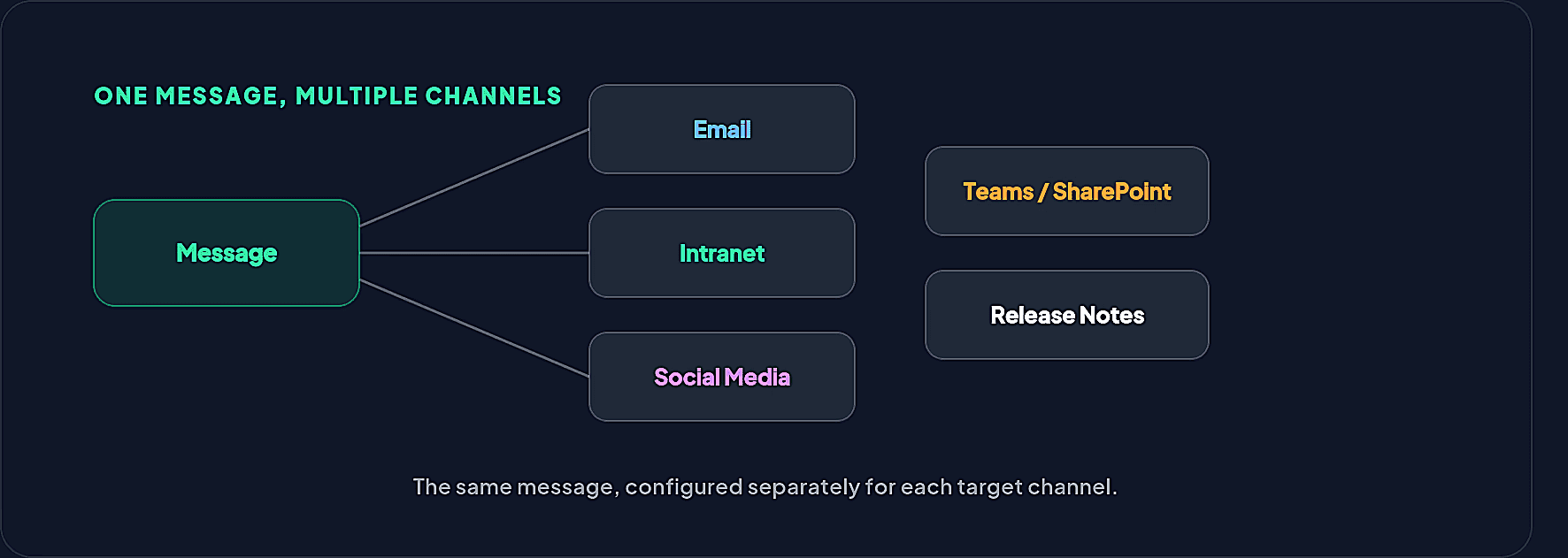
For communication teams, every message means a series of decisions: who sends it, who should receive it, which channels it needs to reach recipients through, whether it requires approval, and when it should go live.
The task within the challenge was to explore how all of these activities could be combined into one coherent product experience — instead of treating them as separate, scattered tasks.
I worked on this project solo, from 0 to 1, as part of Żabka Future — AI Supercharge Challenge, taking full ownership of the product concept and design direction end-to-end.

Problem
One question that set the entire direction.
How might we make internal communication easier to create, control and distribute?
The starting point was a simple need: communication teams needed one central place to manage internal communication. Instead of treating publishing as a single action, I focused on the decisions that surround every message.
That's where the opportunity emerged to connect the full message lifecycle — shown above as Create → Review → Approve → Target → Schedule → Distribute.
Before designing the editor, I mapped what surrounds it. I started by reviewing competitive and related products to understand how communication workflows are typically built, and where each part of the experience usually sits within a typical product.
Who is communicating?
Who should receive it?
Who needs to approve it?
Where should it appear?
When should it be published?
That led me to a product model where communication is managed as one connected system — not a sequence of separate tools.
The entire message lifecycle connected in one place — from the first content decision to reaching the employee.

Solution
One system, four connected jobs.
I worked on this project solo, from 0 to 1, covering the full design scope — product concept and naming, competitive research, information architecture, UX/UI, design system, AI interaction design, content, and the final prototype. I used stakeholder feedback to refine the direction and priorities.
Key Decisions
Instead of walking through screen after screen, here are four design decisions along with the problem each one solved and the reasoning behind it.




Reflection
Designing a system changed how I look at a problem.
This project reinforced my approach to 0→1 product design: the opportunity usually isn’t in adding more features, but in connecting decisions that already belong to the same user journey.
The strongest part of the concept was connecting creation, recipient selection, approval, distribution, scheduling, and AI support into one coherent system. This experience also confirmed how I want to use AI in product design: not as a feature bolted on for its own sake, but as a capability that supports real product tasks while leaving people in full control.
What’s next: validating the employee side — how recipients discover, prioritize, and consume internal communication once it reaches them.